
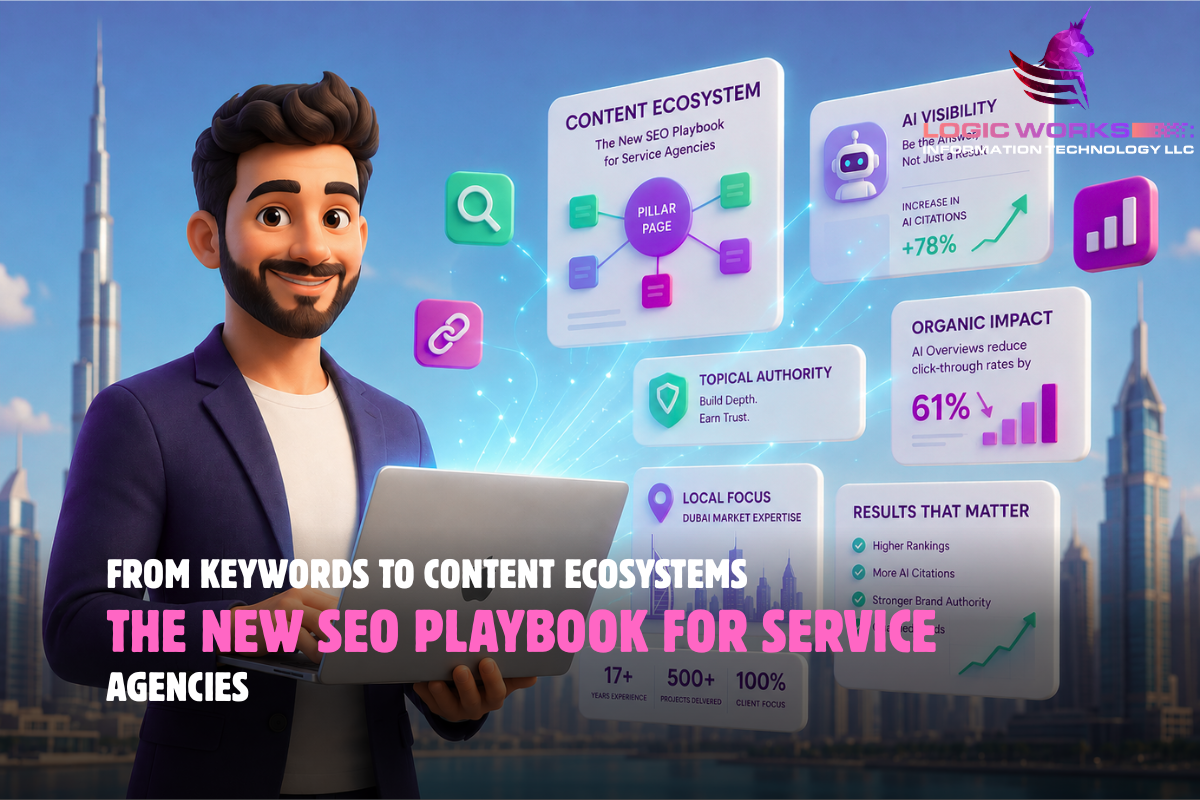
If you run a startup or a Dubai-based business and you are searching for an SEO Services Agency in Dubai, you have probably noticed one thing: ranking on Google is no longer about stuffing a single keyword into a blog post and waiting for traffic. The search landscape has shifted. AI Overviews now answer questions directly on the results page. ChatGPT, Gemini, and Perplexity are becoming the first stop for research. Organic click-through rates drop by up to 61% when AI summaries appear.
This means the old playbook target isolated keywords, publish standalone articles, and chase backlinks is losing effectiveness. The new playbook is about building content ecosystems: interconnected, intent-driven content structures that signal expertise to both search engines and AI answer engines.
At Logic Works, we have spent over 17 years delivering digital solutions to startups and businesses across Dubai. We have seen firsthand how agencies that adopt ecosystem thinking outperform those still chasing vanity keywords. This guide explains what changed, why it matters, and how to build a content ecosystem that ranks and gets cited by AI.
Why Keyword-First SEO Is No Longer Enough
For years, the standard approach for any search engine optimization agency was straightforward: identify high-volume keywords, create a page or post for each, and optimize titles, headers, and meta descriptions. This worked when search engines matched queries to individual pages.
That model is breaking down for three reasons:
- AI engines summarize instead of sending traffic. Google’s AI Overviews and tools like ChatGPT pull answers directly from content, reducing the need to click through to a website.
- User journeys are conversational and multi-step. A prospect does not search “SEO services” once and convert. They ask follow-up questions, compare options, and seek proof—often within a single AI chat session.
- Search engines now evaluate topical authority, not keyword density. Google and AI models assess whether your entire site demonstrates depth on a subject, not just whether one page mentions a phrase.
The result? A single blog post targeting “SEO Services Agency in Dubai” will struggle to rank unless it sits within a broader ecosystem that covers related intent: local SEO, technical audits, content strategy, pricing models, and case studies.
What Is a Content Ecosystem?
A content ecosystem is a structured network of interlinked pages and resources that collectively answer every question a potential client might ask about a topic. Instead of one page fighting alone, multiple pages support each other passing authority, context, and relevance across the site.
Think of it as moving from a collection of individual articles to a topic cluster:
- Pillar page: A comprehensive guide to a core service (e.g., “SEO Services in Dubai: A Complete Guide for Startups”).
- Cluster content: Supporting articles that explore subtopics in depth (e.g., “Technical SEO Audits for Dubai E-Commerce Sites,” “How Local SEO Drives Foot Traffic in the UAE,” “Content Strategy vs. Link Building: What Works in 2026”).
- Internal linking: Every cluster page links back to the pillar and to related cluster pages, creating a web of relevance that search engines and AI models can easily parse.
This approach aligns with how AI answer engines work. Large language models use Retrieval-Augmented Generation (RAG) to pull from multiple web sources and synthesize answers.
When your site offers a dense, well-linked network of related content, AI systems are more likely to cite you repeatedly across different queries.
How to Build a Content Ecosystem for a Service Agency
Start with Intent Mapping, Not Keyword Volume
Before writing, map the actual questions your audience asks. At Logic Works, we pull these from:
- Google Search Console query data
- “People Also Ask” boxes for SEO services and related terms
- Sales call transcripts and support tickets
- Reddit, Quora, and industry forums
Group these questions by intent stage:
| Intent Stage | Example Question | Content Type |
| Awareness | “What does an SEO agency do?” | Educational blog, glossary |
| Consideration | “How much do SEO services cost in Dubai?” | Pricing guide, comparison post |
| Evaluation | “Best SEO Services Agency in Dubai for startups” | Case study, service page |
| Decision | “How do I hire an SEO agency?” | FAQ, consultation CTA |
This intent-first structure ensures your ecosystem answers real questions, not just keyword variations.
Create Pillar Pages That Anchor Your Authority
A pillar page is the definitive resource on a core topic. For a search engine optimization agency serving Dubai, a pillar page might cover:
- What SEO services include (technical audits, on-page optimization, content strategy, link building)
- Why Dubai businesses need localized SEO
- How to measure SEO ROI
- Common mistakes startups make when hiring an agency
The pillar page should be comprehensive (2,000–3,000 words), well-structured with clear H2s and H3s, and include an answer-first summary at the top. AI engines prioritize content that surfaces the core answer immediately, then elaborates.
Develop Cluster Content That Proves Depth
Cluster content explores specific angles that the pillar page only touches on. For Logic Works, this might include:
- “Core Web Vitals and Page Speed Optimization for Dubai Websites”
- “How Schema Markup Improves Visibility in AI Overviews”
- “SEO for Fintech Startups: Compliance and Content Strategy”
- “AEO vs. SEO: Why Answer Engine Optimization Matters in 2026”
Each piece should link back to the pillar page and to 2–3 related cluster articles. This internal linking distributes authority and signals to Google that your site has genuine topical depth—not just a thin layer of keyword-targeted pages.
Optimize for AI Citations, Not Just Rankings
AI visibility is becoming as important as organic clicks. Brands are now tracking how often they get cited in AI Overviews, ChatGPT answers, and Gemini responses.
To increase citation rates:
- Use answer-first formatting. Place a 1–2 sentence direct answer immediately under each H2 or H3.
- Add FAQ schema. Structured data helps AI engines extract and verify your answers.
- Write in tight, scannable blocks. Short paragraphs, bullet points, and numbered lists are easier for AI to parse and summarize.
- Maintain entity consistency. Use the same terminology for your services, locations, and brand positioning across every page. Inconsistent phrasing confuses AI models and reduces citation accuracy.
Why This Matters for Dubai-Based Businesses
Dubai’s digital market has unique characteristics that make ecosystem SEO especially valuable:
- High competition in professional services. Hundreds of agencies compete for the same SEO services keywords. A content ecosystem differentiates you by demonstrating expertise that single pages cannot.
- Local intent is strong. Users search for “SEO Services Agency in Dubai” because they want local expertise, face-to-face consultation, and understanding of the UAE market. Local pages with clear NAP details, service descriptions, and hyper-local content perform better in AI answers.
- Startups need trust signals. New businesses in Dubai are cautious about vendor selection. A well-built ecosystem with case studies, transparent processes, and educational content builds the trust required to convert.
At Logic Works, we build these ecosystems for our clients because we know that in a market as dynamic as Dubai, visibility without authority is temporary.
Measuring Success in an AI-First World
Traditional SEO metrics rankings, traffic, backlinks still matter. But in 2026, you need to add AI-specific KPIs:
- AI citation frequency: How often does your brand appear in ChatGPT, Gemini, or Perplexity answers for your target topics?
- AI Overview inclusion: Does Google cite your content in AI-generated summaries?
- Zero-click influence: Even when users do not click, does your brand shape their understanding and decision-making?
These metrics reflect a shift from “How do we rank?” to “How do we get chosen as the answer?”
FAQs
What is a content ecosystem in SEO?
A content ecosystem is a network of interlinked pages centered around a core topic. It includes a comprehensive pillar page and multiple cluster articles that explore subtopics in depth. This structure signals topical authority to search engines and increases the likelihood of AI citations.
How does a content ecosystem differ from traditional keyword targeting?
Traditional keyword targeting focuses on optimizing individual pages for specific phrases. A content ecosystem focuses on covering an entire topic comprehensively, answering every question a user might ask, and linking related content so authority flows across the site. This approach aligns better with how AI engines synthesize answers.
Why should Dubai businesses invest in ecosystem SEO?
Dubai’s competitive digital market rewards agencies that demonstrate deep expertise. A content ecosystem builds trust with local startups and businesses by providing transparent, educational content that covers their full decision-making journey from initial research to vendor selection.
What is Answer Engine Optimization (AEO), and how does it relate to SEO?
AEO is the practice of optimizing content so AI answer engines can easily extract and cite it. It is the natural evolution of SEO. While traditional SEO focuses on ranking in blue-link results, AEO focuses on appearing in AI Overviews, ChatGPT responses, and voice search answers. The two work best when unified into a single strategy.
How long does it take to see results from a content ecosystem?
Most agencies see early signals—improved indexing, featured snippets, and initial AI citations—within 2 to 6 weeks. For competitive keywords like “SEO Services Agency in Dubai,” meaningful ranking improvements and consistent AI visibility typically take 3 to 6 months of sustained publishing and optimization.
Final Thoughts
The shift from keywords to content ecosystems is not a trend—it is a structural change in how search and AI engines evaluate and surface information. For service agencies, especially those serving competitive markets like Dubai, the winners will be the ones who build depth, not just density.
At Logic Works, we apply this playbook every day. We do not chase isolated rankings. We build content ecosystems that establish our clients as the definitive answer in their space—whether that answer appears in a Google search result, an AI Overview, or a ChatGPT conversation.