


Hiring a digital marketing consultant in Dubai should give your business more than a list of campaigns to launch. The first 90 days should create clarity. Your consultant needs to understand how customers currently find you, where marketing spend is going, which activities generate qualified leads, and what is stopping better results.
That does not mean changing everything in the first week.
A good consultant starts by understanding the business, fixing measurement gaps, identifying priorities, and then testing improvements in a controlled way. By the end of the first three months, you should have a much clearer picture of what works, what does not, and where marketing resources should go next.
Why the First 90 Days Matter
Marketing problems are often connected.
Poor Google Ads performance may actually come from a weak landing page. Low organic traffic may be caused by technical SEO issues rather than a lack of blog content. Plenty of leads may be coming in, but sales teams may consider most of them unqualified.
If a consultant starts launching campaigns before understanding those relationships, the business can end up spending more without learning much.
The first 90 days should therefore follow a simple process:
Understand → Measure → Prioritize → Test → Improve
Each phase should build on the one before it.
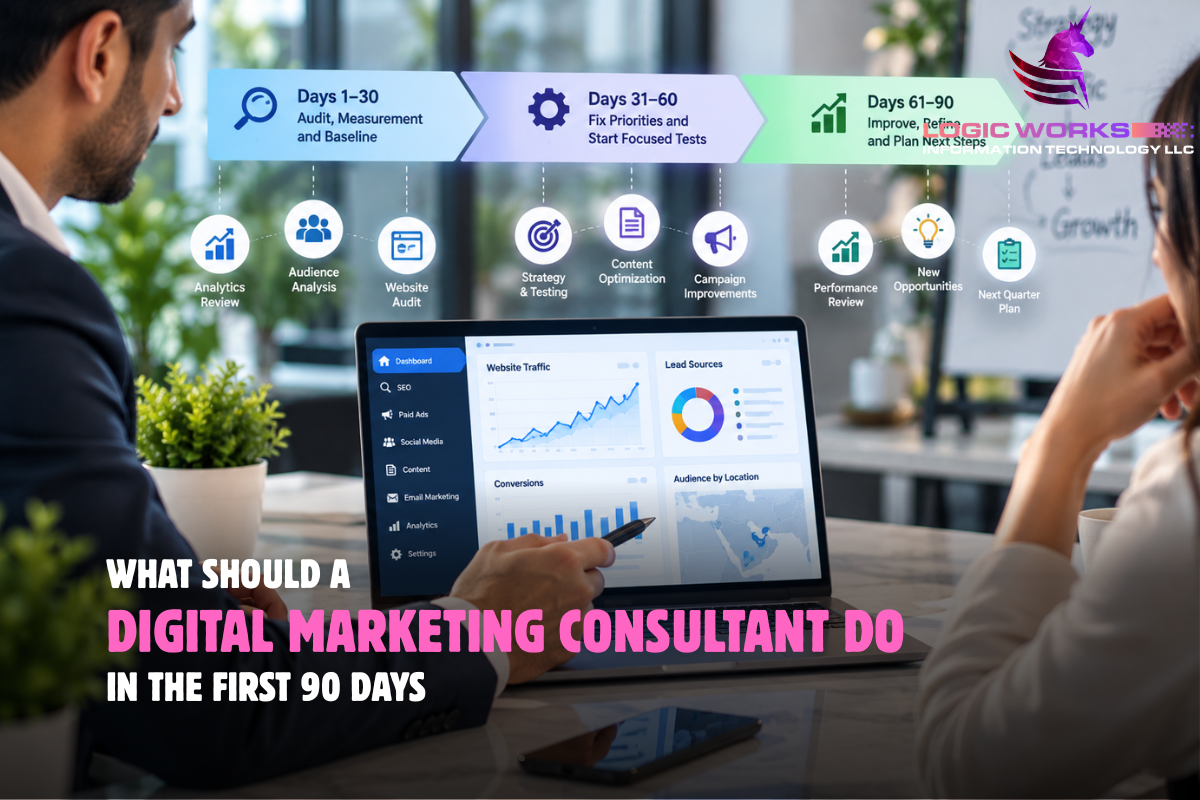
Days 1–30: Audit, Measurement and Baseline
The first month is about understanding where the business stands today.
Before recommending more SEO, paid advertising, social media, or content, the consultant should review the current marketing system.
Understand the Business Goals
The consultant should first ask what the business actually wants to achieve.
That could be:
- more qualified enquiries
- ecommerce sales
- appointment bookings
- local visibility
- higher-quality B2B leads
- lower customer acquisition costs
- stronger brand awareness
“Get more traffic” is usually not enough.
Traffic only matters when the right people visit the website and take useful actions.
Review Existing Marketing Channels
The consultant should review the channels the business already uses.
This may include:
- SEO
- Google Ads
- Meta advertising
- email marketing
- social media
- content marketing
- Google Business Profile
- referral traffic
The goal is not to keep every channel active.
Some may deserve more investment. Others may need major changes, and some may not be worth prioritizing at all.
Check Analytics and Conversion Tracking
You cannot improve marketing reliably if you cannot measure what happens after someone clicks.
During the first month, a consultant should verify whether important actions are being tracked correctly.
These could include:
- contact form submissions
- phone calls
- WhatsApp enquiries
- purchases
- bookings
- quote requests
- downloads
- demo requests
They should also check whether analytics, advertising platforms, and CRM data tell a consistent story.
A campaign that reports 100 leads is not necessarily successful if only five of those leads are relevant to the sales team.
Audit the Website and Conversion Journey
Marketing performance does not stop at the click.
The consultant should review what happens when someone reaches the website.
Can visitors quickly understand the offer?
Is the next step clear?
Does the website work properly on mobile?
Are forms too long?
Are service pages answering the questions potential customers actually have?
A weak conversion path can waste both organic traffic and advertising budget.
Days 31–60: Fix Priorities and Start Focused Tests
By the second month, the consultant should have enough information to stop guessing.
Now the focus shifts from diagnosis to improvement.
Fix the Most Important Problems First
Not every marketing problem deserves equal attention.
If conversion tracking is broken, fixing it may be more important than launching another campaign.
If an important service page already receives thousands of search impressions but few clicks, improving that page may be more valuable than publishing five new blogs.
If paid search is generating irrelevant enquiries, keyword targeting and negative keywords may need attention before the budget increases.
A strong consultant works by priority, not by checklist.
Improve High-Intent Pages
Pages closest to a buying decision deserve particular attention.
These may include:
- service pages
- product pages
- location pages
- landing pages
- contact pages
Improvements might involve clearer headlines, stronger service explanations, better calls to action, FAQs, proof, testimonials, or a simpler enquiry process.
SEO and conversion optimization should support each other.
Ranking a page is useful. Making that page more helpful to potential customers is better.
Refine Paid Advertising
If the business uses Google Ads or social advertising, the consultant should review whether campaigns match actual customer intent.
This can include:
- search terms
- keyword targeting
- audience targeting
- negative keywords
- ad messaging
- landing pages
- conversion tracking
- budget allocation
The goal during this stage is usually not aggressive scaling.
It is learning.
A smaller, well-measured campaign can reveal more than a large campaign with unclear tracking.
Build a Useful Content Plan
Content should support real customer questions and commercial priorities.
A consultant should identify where useful content is missing.
For example, a software company may need content explaining development costs, platform choices, integrations, or project planning.
A healthcare business may need clear service information and patient guidance.
A professional service company may benefit from practical comparison and decision-making content.
The best topic is not always the keyword with the highest search volume.
It is often the topic that helps the right customer make a better decision.
Days 61–90: Measure, Refine and Decide What to Scale
Month three is where the early strategy should begin producing useful information.
Not every test will work.
That is normal.
The consultant should now compare results, identify patterns, and decide which activities deserve more attention.
Review Lead Quality, Not Just Lead Volume
One of the most useful conversations between a consultant and a business happens outside the marketing dashboard.
Ask the sales team:
Which enquiries were qualified?
Which became opportunities?
Which were irrelevant?
What questions did prospects repeatedly ask?
This feedback can improve targeting, advertising copy, landing pages, and content.
Twenty relevant enquiries may be worth more than 100 low-quality leads.
Compare Channel Performance
By this stage, the consultant should begin showing how different channels contribute to business goals.
For example:
SEO may generate fewer leads but higher-intent enquiries.
Paid search may generate faster demand but at a higher acquisition cost.
Social media may support awareness and remarketing rather than direct conversions.
Email may help convert people who were not ready to buy during their first visit.
Each channel has a different job.
A digital strategy becomes stronger when channels support each other rather than compete for credit.
Decide What to Scale
The end of the first 90 days should lead to better decisions.
A consultant should be able to explain:
- what improved
- what did not
- which channels deserve more investment
- which campaigns should change
- which pages need further work
- which content opportunities matter next
- where budget is being wasted
- what should happen during the next quarter
If every recommendation is simply “spend more,” something is missing.
What Should a 90-Day Marketing Report Include?
At the end of the first three months, you should receive more than charts.
The report should explain the story behind the numbers.
Useful metrics may include:
- qualified leads
- sales or revenue where measurable
- conversion rate
- cost per lead
- customer acquisition cost
- advertising return
- organic clicks and impressions
- landing-page performance
- local search visibility
- important keyword movements
- lead quality
It should also document what was changed and what the consultant learned from those changes.
The most useful question is not:
“Did traffic increase?”
It is:
“Are we attracting more of the people the business actually wants to reach?”
Red Flags During the First 90 Days
Some warning signs become obvious early.
Be cautious if a consultant:
- launches campaigns before checking tracking
- recommends every marketing channel at once
- cannot explain where leads come from
- focuses mainly on followers and impressions
- guarantees specific rankings
- changes campaigns constantly without gathering enough data
- publishes content without a clear purpose
- does not ask about sales quality
- refuses to provide account access
- cannot explain the next priority
Good marketing requires testing, but every test should have a reason.
What Should a Digital Marketing Consultant Ask You?
A consultant should ask questions too.
Expect discussions about:
Who are your highest-value customers?
Which services are most profitable?
Where do your best leads currently come from?
How long is your sales cycle?
Which enquiries usually fail to convert?
What makes customers choose you over a competitor?
What marketing has already been tried?
Which systems does your sales team use?
These questions help connect marketing decisions to the real business.
Without that context, marketing can become a collection of disconnected activities.
What Happens After the First 90 Days?
The first 90 days are not the end of the strategy.
They are the foundation.
The next phase should use what the business has learned to improve performance more confidently.
That might mean investing more in high-performing campaigns, expanding SEO content, improving key landing pages, strengthening local visibility, testing new audiences, or fixing weaknesses in the customer journey.
Priorities should continue changing as new information becomes available.
How Logic Works Information Technology Approaches Digital Marketing
At Logic Works Information Technology, digital marketing works best when strategy, measurement, website performance, SEO, paid media, and content connect to the same business goal.
The first step should not be choosing a channel.
It should be understanding what the business wants to achieve, how its current marketing performs, and where the biggest opportunities or problems exist.
From there, the next 90 days can focus on the changes most likely to improve qualified traffic, enquiries, and measurable business performance.
A good digital marketing consultant should leave your business with more than campaigns.
After 90 days, you should have clearer data, stronger priorities, better understanding of your customers, and a practical plan for what happens next.