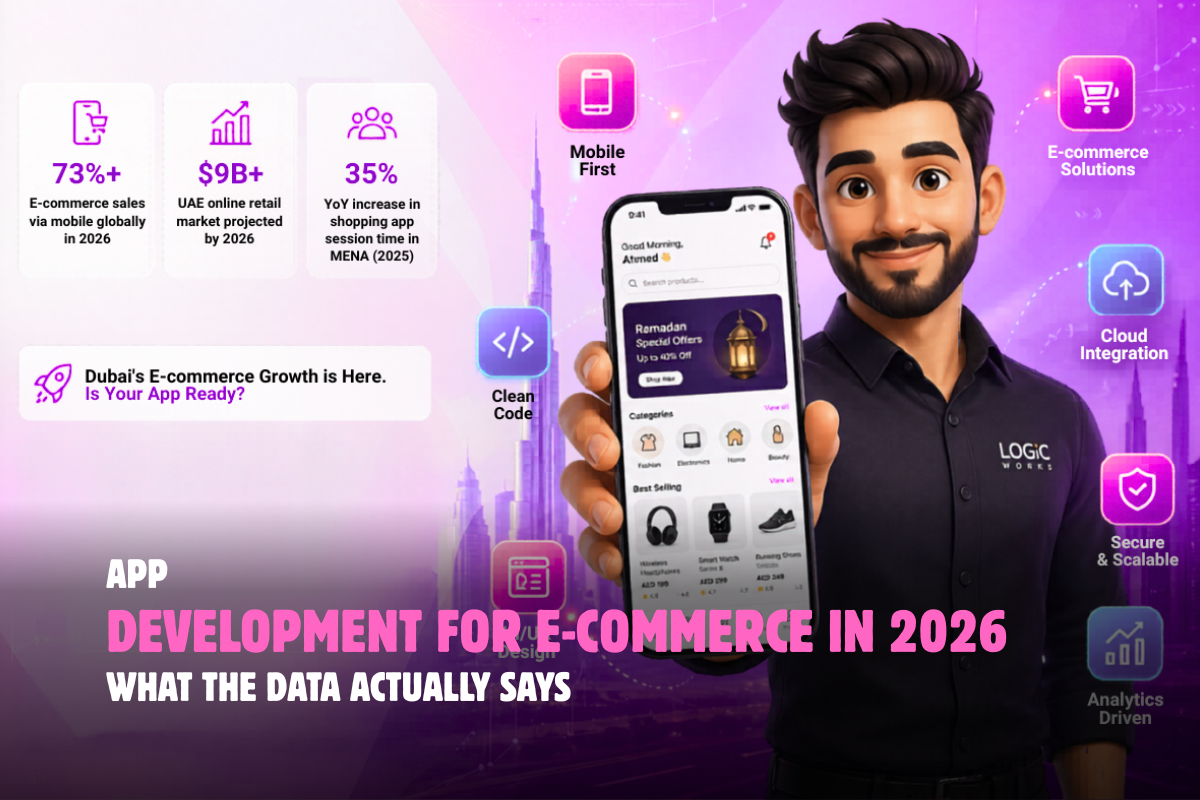
Dubai’s e-commerce market is no longer emerging, it has arrived. With the UAE’s online retail sector projected to surpass $9 billion by 2026, businesses that rely on outdated websites or generic shopping platforms are already falling behind.
The real growth is happening on mobile. Consumers in Dubai and across the GCC increasingly discover, evaluate, and purchase products through apps not browsers. If your business does not have a dedicated, well-built e-commerce app, you are handing sales to competitors who do.
At Logic Works, we have spent over 5+ years building digital products for startups and established businesses across the UAE. In this blog, we break down what the latest data says about e-commerce app development Dubai, what features actually drive growth, and what you need to know before you build.
What Does the 2026 Data Say About Ecommerce App Development in Dubai?
The numbers make a clear case for mobile-first e-commerce.
According to Statista, mobile commerce (m-commerce) accounts for over 73% of all e-commerce sales globally in 2026. In the UAE specifically, smartphone penetration sits above 98%, one of the highest rates in the world. Dubai consumers are not just browsing on mobile; they are buying.
Research from App Annie and data.ai shows that shopping apps in the MENA region saw a 35% year-on-year increase in session time in 2025, with UAE users ranking among the highest in average order values through mobile apps.
The data points to one clear direction: ecommerce app development in Dubai is not a nice-to-have for businesses in 2026. It is a revenue channel business can no longer ignore.
Why Is a Dedicated App Better Than a Mobile Website for Dubai E-commerce?
This is one of the most common questions businesses ask before they invest in app development. The answer comes down to performance, experience, and conversion.
Apps Convert at a Higher Rate Than Mobile Browsers
Data from Criteo consistently shows that e-commerce apps convert 3x higher than mobile websites. The reasons are straightforward, apps load faster, store user preferences, support one-tap checkout, and send push notifications that bring users back.
A Dubai shopper using your app is already invested. They downloaded it, logged in, and gave you permission to communicate with them. That is a fundamentally different relationship than an anonymous browser visit.
Apps Enable Personalization at Scale
Modern e-commerce apps use behavioral data, browsing history, purchase patterns, wishlist activity to personalize the shopping experience in real time. This kind of personalization is technically possible on a website, but apps deliver it faster and with far less friction.
For Dubai businesses serving diverse customer segments across nationalities, languages, and preferences, personalization is not a luxury, it is a conversion tool.
Push Notifications Drive Repeat Purchases
Email open rates in e-commerce average around 20–25%. Push notification open rates for shopping apps range from 40–60%. For time-sensitive promotions, flash sales, Ramadan offers, weekend deals push notifications deliver measurable results that email simply cannot match in the UAE market.
What Features Does a High-Performing Ecommerce App Need in 2026?
Not all e-commerce apps are built equal. The difference between an app users love and one they delete after one session comes down to specific features executed well.
Seamless Onboarding and Guest Checkout
Forcing users to create an account before they can browse or buy is one of the fastest ways to lose a sale. High-performing e-commerce apps in Dubai offer social login (Google, Apple ID), guest checkout, and minimal friction at every entry point.
Multiple Payment Gateway Integrations
Dubai consumers expect flexibility. Your app needs to support credit and debit cards, Apple Pay, Google Pay, cash on delivery, and increasingly buy now pay later (BNPL) options. Tabby and Tamara have seen explosive growth in the UAE, and integrating them directly into your checkout flow reduces cart abandonment significantly.
Arabic Language and RTL Support
Dubai’s population is diverse, but a large segment of your audience is Arabic-speaking. An app that supports right-to-left (RTL) text layout and Arabic language natively is not just culturally respectful it expands your addressable market.
Real-Time Inventory and Order Tracking
Users in Dubai expect Amazon-level visibility into their orders. Real-time inventory management, live order tracking, and automated status updates are baseline expectations in 2026 not premium features.
AI-Powered Search and Product Discovery
Basic keyword search is no longer enough. Leading e-commerce apps now use AI-driven search that understands intent, corrects spelling, and surfaces relevant products even when a user’s query is vague. Visual search where users upload a photo to find similar products, is also gaining traction in fashion and home décor categories popular in Dubai.
Ratings, Reviews, and Social Proof
Trust is the currency of e-commerce. Verified reviews, user-generated content, and product ratings directly influence purchase decisions. Build these into your app architecture from day one, not as an afterthought.
How Much Does Ecommerce App Development Cost in Dubai?
Cost is always a key consideration, and it varies significantly based on what you are building.
A basic e-commerce app with standard features product listings, cart, checkout, and user accounts typically ranges from AED 25,000 to AED 60,000 for a single platform (iOS or Android).
A mid-tier app with custom UI/UX, multiple payment gateways, push notifications, Arabic support, and basic analytics ranges from AED 60,000 to AED 150,000.
An advanced app with AI-powered features, real-time inventory sync, third-party integrations (ERP, CRM, logistics APIs), and dual-platform development (iOS + Android) can range from AED 150,000 upward depending on scope.
At Logic Works, we work with startups and growing businesses to scope projects realistically building what drives growth now, with an architecture that scales as the business grows. We do not upsell features you do not need.
What Is the Right Tech Stack for a Dubai Ecommerce App in 2026?
The technology you build on shapes your app’s performance, scalability, and long-term maintenance costs.
React Native vs. Flutter for Cross-Platform Development
For most Dubai e-commerce businesses, cross-platform development building one codebase that runs on both iOS and Android is the practical choice. It reduces development time and cost without sacrificing quality.
React Native (backed by Meta) and Flutter (backed by Google) are the two leading frameworks in 2026. Both deliver near-native performance. Flutter has an edge in UI consistency across devices; React Native has a larger developer community and stronger JavaScript ecosystem integration.
At Logic Works, we evaluate the right framework based on your specific product requirements not a one-size-fits-all preference.
Backend: Node.js, Firebase, or Custom APIs
Your backend infrastructure determines how well your app handles traffic spikes critical during sales events and campaigns. We build scalable backend architectures using Node.js, Firebase, or custom REST/GraphQL APIs depending on complexity and expected load.
Headless Commerce Integration
Many Dubai businesses are moving toward headless commerce, where the frontend app connects to a separate backend commerce engine (like Shopify, Magento, or a custom solution). This gives you flexibility to update the app experience without rebuilding your entire commerce infrastructure.
How Does Logic Works Approach Ecommerce App Development in Dubai?
We follow a structured, six-phase process:
1. In-Depth Business Analysis — We study your product catalogue, target audience, competitor apps, and business model before writing a single line of code.
2. Comprehensive Market Research — We identify user behavior patterns specific to Dubai and the GCC, including payment preferences, browsing habits, and seasonal buying trends.
3. Strategic Planning — We define the feature roadmap, platform priority, and technical architecture based on your budget and growth targets.
4. Creative UI/UX Design — Our designers build an interface that reflects your brand and prioritizes conversion not just aesthetics. Every screen is tested for usability before development begins.
5. Development and QA — Our developers build and rigorously test the app across devices, screen sizes, and network conditions common in the UAE.
6. Launch, Support, and Continuous Improvement — We do not disappear after launch. We monitor performance, gather user data, and continue improving the app based on real behavior.
Frequently Asked Questions
How long does ecommerce app development take in Dubai?
A standard e-commerce app typically takes 12–20 weeks from scoping to launch, depending on feature complexity and platform requirements. At Logic Works, we provide a clear timeline during the planning phase so there are no surprises.
Should I build an iOS app, Android app, or both for the Dubai market?
In the UAE, both iOS and Android have strong user bases. For most Dubai e-commerce businesses, a cross-platform app built with React Native or Flutter is the most cost-effective starting point delivering a high-quality experience on both platforms from a single codebase.
What makes a good ecommerce app development company in Dubai?
Look for a team with proven e-commerce app case studies, full-cycle development capability (design, development, QA, and post-launch support), and experience with UAE-specific requirements like Arabic RTL support and local payment gateway integration.
Can I integrate my existing Shopify or WooCommerce store into a mobile app?
Yes. Logic Works builds headless commerce solutions that connect your existing Shopify, WooCommerce, or Magento backend to a custom mobile app frontend so you keep your current catalogue and order management while giving users a far better mobile experience.
What is the most important feature for an ecommerce app targeting Dubai shoppers?
Multiple payment options including Apple Pay, Google Pay, and BNPL services like Tabby and Tamara combined with real-time order tracking and Arabic language support are the features that most directly impact conversion and retention in the Dubai market.
Final Word
The data is unambiguous. Mobile commerce is the primary growth channel for e-commerce businesses in Dubai and the UAE in 2026. Businesses that invest in well-built, user-focused e-commerce apps will capture that growth. Those that do not will continue losing ground to competitors who move faster.
At Logic Works, we build e-commerce apps that are designed to convert, engineered to scale, and built specifically for the Dubai market. Whether you are launching your first app or rebuilding an underperforming one, our team is ready to help you do it right.
Get in touch with Logic Works to discuss your ecommerce app project today.
Logic Works is a leading digital solutions provider in the GCC, specialising in mobile app development, web development, digital marketing, and AI-powered solutions for startups and Dubai-based businesses.