



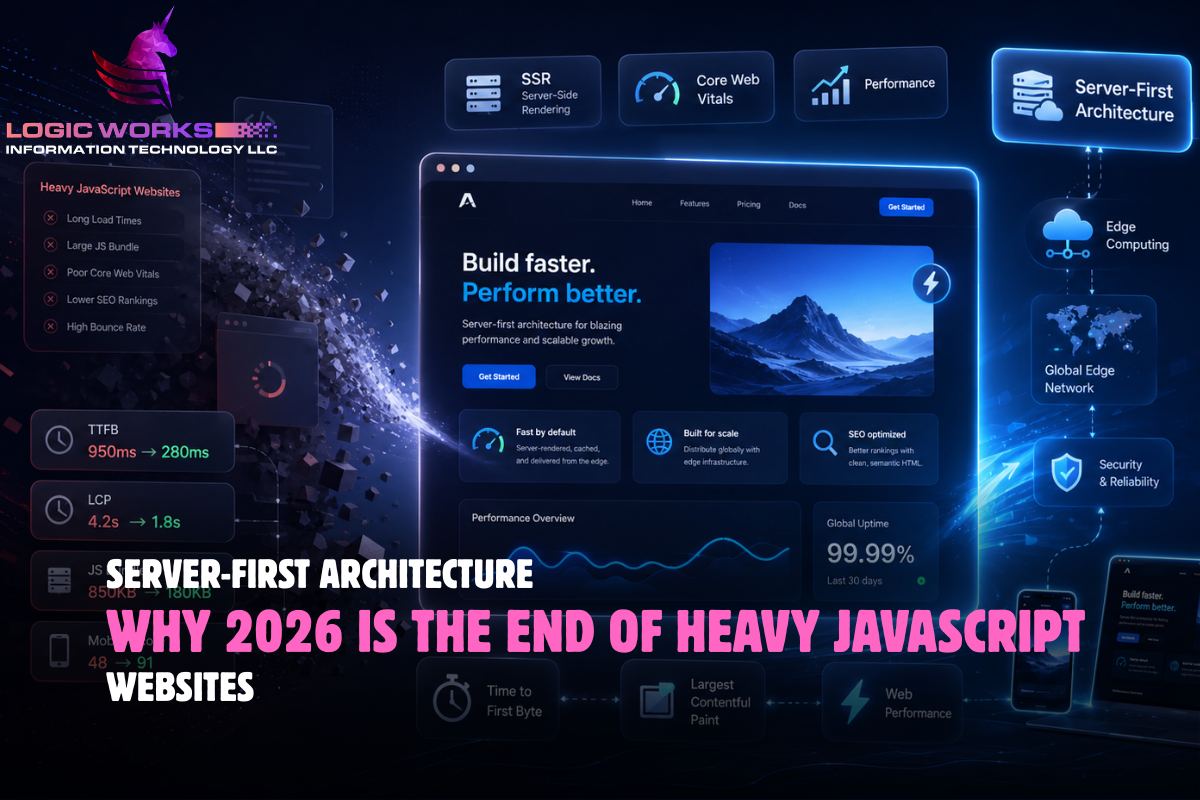
For years, modern websites have relied on large JavaScript bundles to create smooth, app-like experiences. That approach worked when teams prioritized interactivity above everything else. In 2026, the priorities have changed. Businesses now need faster loading, stronger SEO visibility, better Core Web Vitals, and consistent performance across mobile devices.
This is why server-first architecture is becoming the new standard. Instead of forcing the browser to download, parse, and execute excessive JavaScript before users see meaningful content, server-first websites deliver usable HTML earlier and reserve JavaScript only for what truly needs interaction.
What Is Server-First Architecture?
Server-first architecture is a web development approach where pages are rendered primarily on the server or at the edge before reaching the browser. It sends meaningful HTML first, reduces unnecessary client-side JavaScript, and uses hydration only where interactivity is needed, improving speed, SEO, and user experience.
Traditional single-page applications depend heavily on client-side rendering. The browser downloads a JavaScript bundle, builds the interface, fetches data, and then displays content. Server-first architecture reverses that flow. The server prepares the page earlier, so users and search engines receive content faster.
The Problem: Why Heavy JavaScript Websites Are Failing
Heavy JavaScript websites are failing because users no longer tolerate slow experiences. HTTP Archive data shows that the median mobile homepage in 2025 was over 2.5 MB, with JavaScript remaining one of the largest contributors to page weight. Every extra script increases download time, parsing cost, memory use, and battery drain.
The business impact is direct. Google recommends a Largest Contentful Paint of 2.5 seconds or faster for a good user experience. Slow pages often struggle with Core Web Vitals, which affects search visibility, user trust, and conversion performance. A Deloitte and Google study also found that improving mobile speed by just 0.1 seconds can increase conversions in retail and travel.
This matters even more in competitive markets where customers compare brands quickly. A slow website does not simply create a technical issue. It creates hesitation, abandonment, and lost revenue.
Server-First vs Client-Side Rendering: Key Differences
| Factor | Server-First Architecture | Client-Side Rendering |
| Initial Load | Sends usable HTML early | Waits for JavaScript execution |
| SEO | Easier for crawlers to read content | Content may depend on client rendering |
| Time to First Byte | Can be optimized through server and edge rendering | May be fast initially, but content appears later |
| JavaScript Bundle | Smaller and more targeted | Often larger and app-wide |
| Hosting Cost | Can reduce client-side complexity and caching overhead | May require more API calls and complex delivery |
The difference is not just technical. Server-side rendering improves the moment users first see content, while client-side rendering often delays that moment until the browser completes more work. For content-heavy websites, landing pages, e-commerce pages, blogs, and service pages, server-first is usually the stronger choice.
5 Benefits of Server-First Architecture
1. Blazing Fast Page Loads
Server-first architecture improves web performance by delivering ready-to-render HTML before large scripts take control. This reduces the work required on the user’s device and helps improve Largest Contentful Paint.
For businesses evaluating web development services, speed should now be treated as a core feature, not a final optimization step.
2. Superior SEO Performance
Search engines can crawl and understand server-rendered content more reliably. When key headings, service copy, product details, and internal links exist in the initial HTML, indexing becomes cleaner and faster.
This is especially important for companies investing in web development services in Dubai, where local search competition is intense and technical SEO can influence visibility from day one.
3. Reduced Hosting Costs
A server-first approach can lower waste by caching rendered pages, reducing unnecessary API requests, and sending less JavaScript to every visitor. Static generation and edge caching also help websites serve repeat traffic efficiently.
Modern web development services should consider the total cost of ownership, not just the initial build price.
4. Enhanced Security
Server-first websites expose less logic to the browser. Sensitive operations such as authentication checks, database queries, and business rules can remain on the server instead of being pushed into client-side code.
This does not remove the need for security best practices, but it reduces the attack surface and makes architecture easier to control.
5. Better User Experience Across Devices
Not every visitor uses a flagship phone or high-speed connection. Server-first architecture improves accessibility for users on older devices, mobile networks, and low-power browsers.
High-quality web development services must account for real-world conditions, not just perfect lab tests.
Server-First in 2026: Frameworks Leading the Shift
Next.js App Router
Next.js App Router supports React Server Components, server-side rendering, static rendering, streaming, and selective client components. This allows developers to keep most logic on the server while adding client-side interactivity only where needed.
For complex business websites and SaaS platforms, Next.js provides a practical balance between performance and flexibility.
Astro
Astro is built around an HTML-first approach. By default, it ships minimal JavaScript and uses an islands architecture where only interactive components hydrate in the browser.
This makes Astro a strong option for blogs, landing pages, documentation sites, service websites, and content-heavy marketing platforms.
Fresh
Fresh, built for Deno, follows a server-rendered model with islands for selective interactivity. It sends HTML by default and avoids unnecessary client-side JavaScript unless a component explicitly needs it.
Its architecture fits teams that want fast server rendering, modern tooling, and simple deployment close to users.
Nuxt 3
Nuxt 3 brings server-side rendering, static generation, hybrid rendering, and edge deployment options to the Vue ecosystem. It allows teams to choose the right rendering mode for each route instead of forcing one approach across the full application.
For Vue-based projects, Nuxt 3 offers a mature path toward server-first performance.
Why 2026 Marks the Tipping Point
Several forces are converging in 2026. Core Web Vitals are now part of how businesses evaluate website quality, not just how developers debug performance. Users expect pages to feel instant, especially on mobile.
Developer experience has also improved. Server components, route-level rendering, edge functions, streaming, and partial hydration are now easier to implement than they were a few years ago. Teams no longer need to choose between maintainability and performance.
Edge computing is another major reason for the shift. Rendering closer to the user reduces latency and improves Time to First Byte, especially for businesses serving customers across multiple regions.
Real-World Impact: Before and After
Consider a realistic business website that originally used a heavy client-side rendering setup:
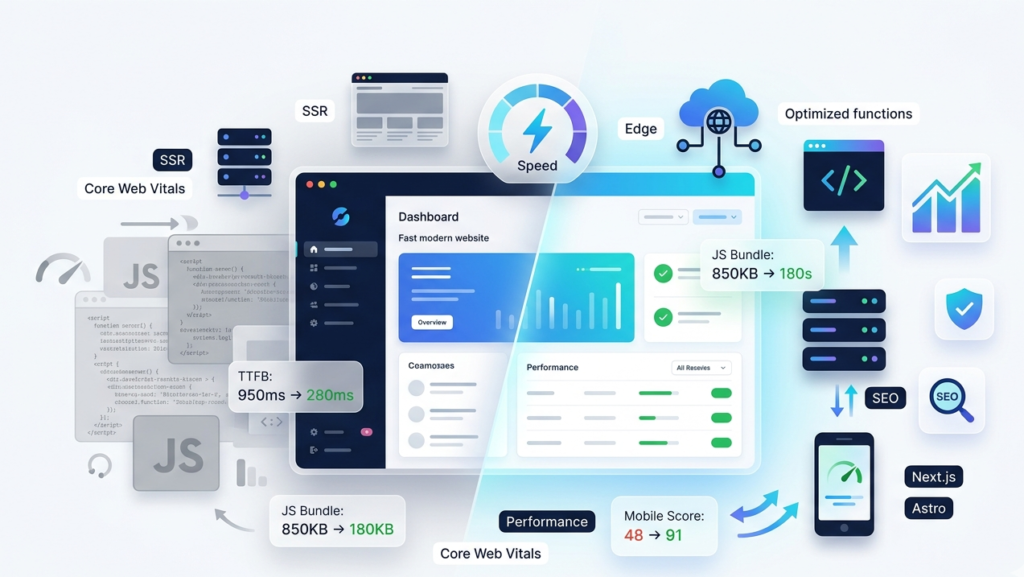
| Metric | Before: Heavy JavaScript SPA | After: Server-First Build |
| Time to First Byte | 950 ms | 280 ms |
| Largest Contentful Paint | 4.2 seconds | 1.8 seconds |
| JavaScript Bundle | 850 KB | 180 KB |
| Mobile Performance Score | 48/100 | 91/100 |
The improvement comes from reducing the JavaScript bundle, rendering key content earlier, caching static sections, and moving data fetching closer to the server. The result is not only a faster website but a smoother buying journey.
Is Your Website Ready for the Server-First Future?
Migrating to server-first architecture starts with an audit. Review your current JavaScript bundle, Core Web Vitals, render-blocking resources, page templates, CMS structure, hosting setup, and third-party scripts.
Not every website needs a complete rebuild. Some can migrate route by route, starting with landing pages, service pages, blogs, and high-value conversion pages. Businesses comparing web development services should ask whether the agency builds around performance from the start or treats speed as a plugin-based fix later.
Conclusion
The end of heavy JavaScript websites does not mean the end of JavaScript. It means the end of sending unnecessary JavaScript to every user, on every page, by default.
Server-first architecture gives businesses a smarter foundation: faster loading, better SEO, stronger Core Web Vitals, lower client-side complexity, and a better experience across devices. In 2026, websites that feel heavy will increasingly feel outdated.
For businesses choosing web development services in Dubai, the future belongs to websites that load fast, rank well, and serve users before asking their browsers to do unnecessary work.
FAQ
Can existing websites migrate to server-first architecture?
Yes. Existing websites can migrate gradually by rebuilding important pages with server-side rendering, static generation, or edge rendering. Many businesses start with high-traffic pages such as the homepage, service pages, product pages, and blog templates.
Does server-first mean no JavaScript at all?
No. Server-first does not remove JavaScript. It uses JavaScript more carefully, sending it only for interactive elements such as filters, forms, dashboards, carts, maps, and account features.
Is server-first suitable for complex web applications?
Yes, but the architecture must be planned carefully. Complex applications can use server-rendered layouts, server components, API routes, and selective client-side interactivity to balance speed, security, and rich functionality.