
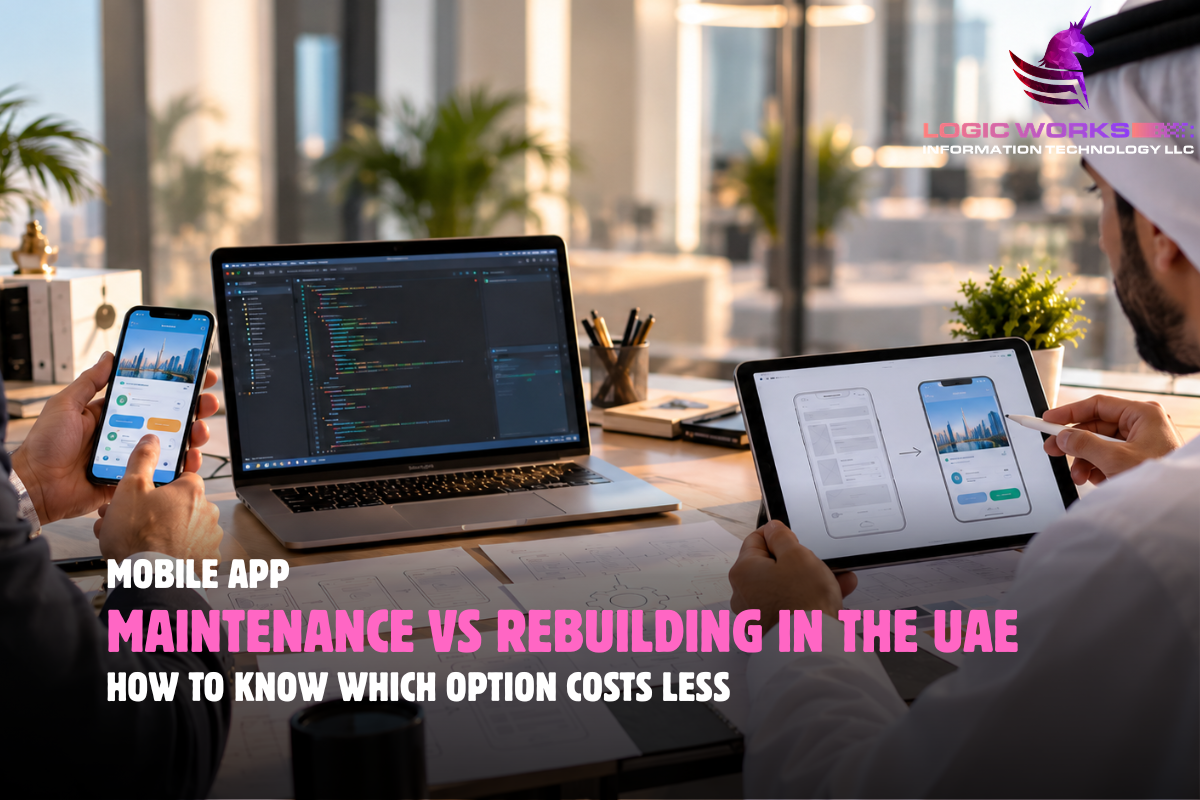
If you already have a live app, choosing whether to maintain it or rebuild it can be more expensive than the original launch decision. A good app development company in Dubai should help you compare the cost of ongoing fixes against the long-term value of a cleaner rebuild, rather than pushing one option by default. In many cases, maintenance makes perfect sense. In others, continuing to patch an ageing app only increases the final cost.
The right choice depends on the condition of your code, the technology behind the app, user expectations, security needs, integrations, and how much the business has changed since the app was first built.
What Does Mobile App Maintenance Actually Include?
Mobile app maintenance is more than fixing bugs when users complain.
A healthy maintenance plan usually covers operating system updates, performance monitoring, security patches, API compatibility, database improvements, cloud infrastructure, third-party integrations, and small usability changes.
For UAE businesses, an app may also depend on payment gateways, delivery APIs, CRM systems, analytics platforms, login services, or other business software. When one of these services changes its API or security requirements, the app may need development work even if nothing appears to have changed from the user’s perspective.
Maintenance therefore protects an existing investment. The question is whether that investment is still worth protecting.
When Maintaining an Existing App Usually Costs Less
Maintenance is normally the better financial decision when the foundation of the application is still sound.
The Codebase Is Stable
If developers can understand the existing code, make changes without breaking unrelated features, and release updates safely, there may be little reason to rebuild.
A well-structured application can continue operating for years with regular updates.
Your Technology Is Still Supported
Frameworks and libraries evolve constantly. That does not mean every older application needs replacement.
If the underlying framework still receives security updates and works reliably with current iOS or Android versions, routine modernization may be enough.
The App Still Matches the Business
Sometimes the technology is fine and the business model has barely changed.
If the same users, workflows, integrations, and features remain relevant, maintaining the app is usually more economical than starting over.
Problems Are Isolated
A slow checkout screen, broken notification system, outdated interface, or unstable API integration can often be repaired individually.
Rebuilding an entire application to solve one weak feature rarely makes financial sense.
Signs That Maintenance Is Becoming Too Expensive
The situation changes when every update creates another problem.
This is usually where technical debt begins turning into a business cost.
Small Changes Take Too Long
Imagine asking for a simple change to a registration form, only to discover that developers need several days because the old code affects multiple screens.
That is a warning sign.
When minor changes repeatedly require large amounts of development time, maintenance costs can quietly become higher than expected.
Bugs Keep Returning
Fixing the same type of problem again and again usually points to a deeper architectural issue.
One bug is normal. A pattern of recurring crashes, failed integrations, database errors, and inconsistent behaviour is not.
The Original Technology Is No Longer Supported
Unsupported frameworks create both maintenance and security problems.
Developers may struggle to find compatible libraries. New operating system versions may introduce issues. Security patches may no longer be available.
At that point, keeping the application alive can become increasingly difficult.
The Business Has Outgrown the Original App
An app designed for 500 users may not be the right foundation for 100,000.
The same applies when a simple consumer app evolves into a platform that needs subscriptions, multiple user roles, Arabic interfaces, live tracking, payment integrations, or complex reporting.
The application may technically still work, but its architecture may no longer fit the business.
When Rebuilding a Mobile App Can Cost Less
A rebuild requires a larger upfront investment, so it can appear more expensive at first.
The comparison changes when you look at several years rather than several weeks.
Suppose an ageing application regularly needs emergency fixes, developer workarounds, server upgrades, and compatibility patches. The business may spend money every month without actually improving the product.
A rebuild can replace those recurring problems with a cleaner foundation.
Working with a software development company in Dubai can also help when the mobile application is only one part of a wider system involving CRM, ERP, APIs, customer portals, or internal business workflows. In that situation, rebuilding around a better architecture may reduce duplication across the entire operation.
Maintenance vs Rebuilding: Compare the Total Cost
Do not make the decision using development price alone.
Look at the total cost of ownership.
Consider:
- Monthly maintenance and support costs
- Developer hours needed for minor changes
- Hosting and infrastructure costs
- Security and compliance work
- Third-party API maintenance
- App Store and Play Store compatibility
- Downtime caused by bugs
- Lost users due to poor performance
- Cost of adding new features
- Difficulty hiring developers for older technology
A cheaper solution today can become the more expensive solution over three years.
That is why the most useful comparison is not “How much does a rebuild cost?”
It is:
What will each option cost the business over the next two to five years?
What About App Modernization?
Maintenance and rebuilding are not the only options.
Sometimes the best answer is modernization.
Instead of replacing the entire application, developers can gradually improve the weakest parts.
For example, a team might keep the existing mobile interface while rebuilding the backend API. Another project might migrate an old database first, then replace individual app modules in phases.
This approach can reduce risk while still addressing technical debt.
It is particularly useful for businesses that cannot afford a long shutdown or a complete platform replacement.
How to Decide Which Option Is Right for Your App
Before approving another maintenance contract or commissioning a rebuild, request a technical assessment.
The review should answer practical questions.
Is the current architecture still suitable? Which technologies are becoming outdated? Are security problems present? How difficult is it to add new features? Can individual modules be modernized? What would maintenance cost over the next few years?
The recommendation should come from those findings.
At Logic Works Information Technology LLC, the goal should not simply be to replace old software because newer technology exists. A rebuild only makes sense when it creates clear technical or commercial value.
Sometimes that means improving the existing app.
Sometimes it means modernizing selected components.
And sometimes the most responsible recommendation is to rebuild.
Common Mistakes UAE Businesses Make Before Rebuilding
One common mistake is rebuilding because the interface looks old.
Design can often be refreshed without replacing the entire application.
Another is continuing maintenance simply because the company has already spent heavily on the existing app. Previous investment should not determine future spending if the technology has become a liability.
Businesses also underestimate integrations. A new mobile app may need to connect with payment providers, logistics systems, accounting software, customer databases, or internal platforms. Those dependencies need to be mapped before anyone estimates a rebuild.
The best decision comes from understanding the whole system, not just the screens users see.
Final Thoughts
Mobile app maintenance is cheaper when the application has a healthy foundation, supported technology, manageable technical debt, and a product structure that still fits the business.
Rebuilding becomes more attractive when maintenance consumes increasing time, updates regularly break features, security risks are growing, or the original architecture prevents the company from moving forward.
There is no universal percentage or formula that answers the question.
Start with a technical review. Compare maintenance, modernization, and rebuilding over several years. Then choose the option that reduces long-term cost while giving the business room to grow.
That approach is far more useful than continuing to patch an app simply because rebuilding feels expensive.