Businesses often hear the word “custom” when comparing website proposals, but it does not always mean the same thing. Custom web design in Dubai should go beyond changing the colors, fonts, and images of a ready-made template. A genuinely custom website is planned around the business, its customers, its content, and the actions visitors need to take.
That does not mean every line of code has to be written from scratch. It means the design and functionality should fit the business instead of forcing the business into a predefined layout.
So, what actually makes a website custom? Let’s break it down.
What Does Custom Web Design Actually Mean?
Custom web design starts with requirements.
Before choosing layouts or visual styles, the design team should understand:
- who the website is for
- what the business offers
- what visitors need to accomplish
- which pages matter most
- what features are required
- how leads or sales will be generated
- which external systems need to connect with the website
A template website usually starts with an existing structure and adjusts it to fit the business.
A custom project works in the opposite direction.
The business requirements come first. The website structure follows.
This difference affects everything from navigation and page layouts to mobile behavior and calls to action.
Custom Design Is More Than a Unique Homepage
A custom homepage can look impressive, but that alone does not make the entire website custom.
The design should account for the full customer journey.
For example, a service business may need:
Home → Service Page → Case Study → Consultation
An ecommerce business may require:
Category → Product → Cart → Checkout
A B2B company may rely on:
Industry Page → Solution → Technical Information → Request a Quote
Each journey requires different information and different page structures.
Custom website design allows these journeys to be planned intentionally rather than squeezed into the sections available in a purchased theme.
Custom Layouts Should Support Real User Needs
Visual design matters, but usability matters more.
A custom layout should help visitors understand the page quickly.
That means thinking carefully about:
Navigation
Visitors should know where to find services, products, company information, and contact options without searching through complicated menus.
Content Hierarchy
Important information should appear where users naturally need it.
Headings, supporting text, visuals, proof, FAQs, and calls to action should work together.
Calls to Action
Not every visitor is ready to buy immediately.
Some may want to request a quote. Others may want to view previous work, speak to someone, compare services, or learn more.
Custom design allows the website to offer the right next step at the right point in the journey.
Does Custom Web Design Mean Custom Code?
Not necessarily.
This is one of the biggest misconceptions about custom websites.
A website can use WordPress, Shopify, Laravel, or another established platform and still have a completely custom user experience.
The platform handles certain standard functions. The design and development team can still create:
- custom page layouts
- reusable components
- custom content structures
- unique user journeys
- tailored integrations
- business-specific functionality
There is no benefit in rebuilding reliable standard technology simply to say that everything was coded from scratch.
Good custom web development focuses effort where customization adds real value.
Custom Functionality and Custom Design Are Different
A website can look simple while doing complex work behind the scenes.
Custom functionality may include:
- booking systems
- customer portals
- quote calculators
- CRM integrations
- payment gateways
- membership areas
- dashboards
- product configurators
- API integrations
- custom forms and workflows
These features are different from visual design.
For example, a business may need a relatively simple corporate website visually, but the contact form may need to send information into a CRM, assign a sales representative, trigger an email, and create an internal record.
That is custom functionality even if the interface looks straightforward.
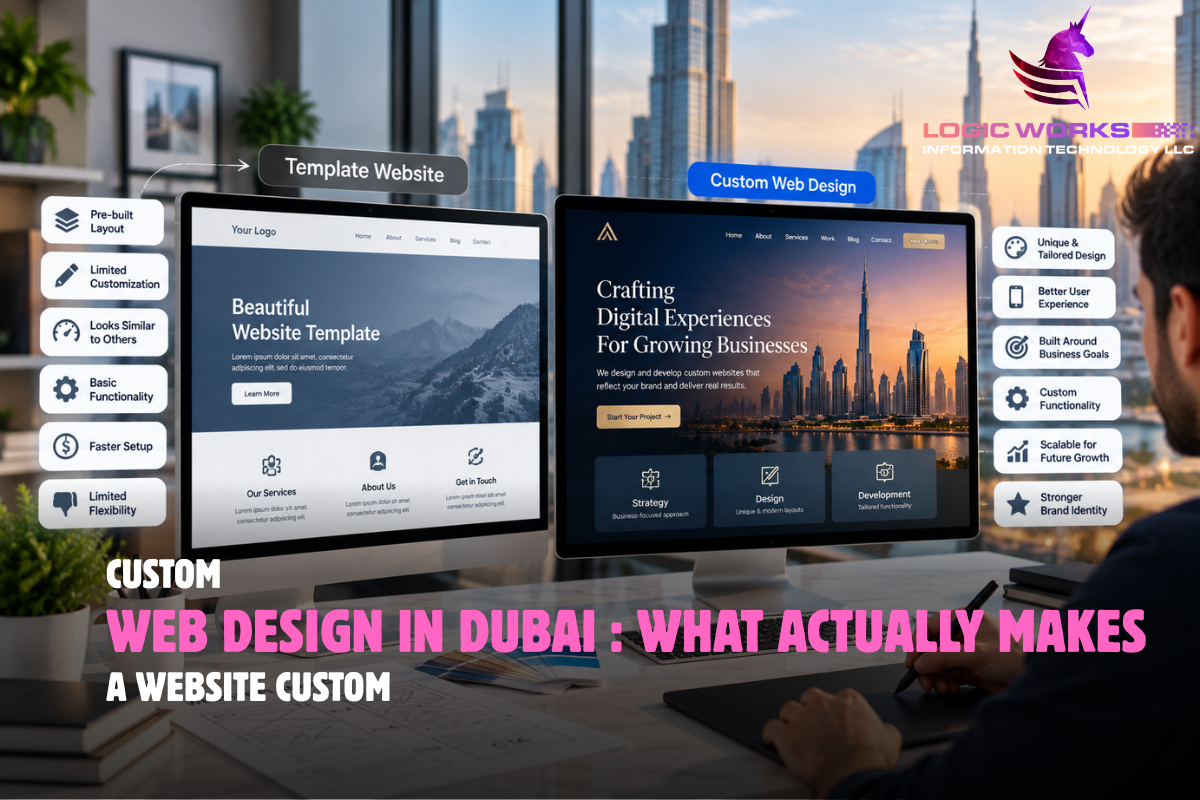
Custom Web Design vs Template Websites
Templates are not automatically bad.
They can be a practical choice when the project is simple.
The key is understanding the trade-off.
Custom Web Design
A custom website usually provides:
- greater design flexibility
- layouts built around the business
- stronger control over user journeys
- easier planning for unique functionality
- more freedom for future expansion
- closer alignment with the brand
Template Website
A template can provide:
- faster setup
- lower initial cost
- proven page structures
- simpler development
- a practical option for basic websites
The limitation appears when the business starts changing the template repeatedly to support requirements it was never designed for.
At that point, the “faster” solution can become difficult to maintain.
When Does a Dubai Business Need a Custom Website?
Not every business needs one.
Custom web design becomes more valuable when standard layouts start limiting what the company needs to accomplish.
You may benefit from a custom approach if:
- your brand needs a distinctive visual identity
- your customer journey is different from competitors
- several business systems need integration
- your website requires unusual functionality
- you serve different customer groups
- you expect the website to expand significantly
- you need advanced ecommerce workflows
- bilingual UX requires careful planning
A growing business may also choose custom design because the website needs to support future services and features without being rebuilt every year.
When Is a Template Website Enough?
A template may be perfectly reasonable for a small business that needs:
- a homepage
- a few service pages
- an about page
- a contact form
- basic company information
It can also work well when the budget or launch timeline is limited.
The important thing is honesty about the requirements.
There is no reason to pay for complex custom development if the business genuinely needs a simple brochure website.
Likewise, a company should not choose a basic template simply because it costs less if the website will need substantial customization immediately.
Mobile Experience Should Be Designed, Not Shrunk
A custom website should consider mobile layouts from the beginning.
Mobile design is not simply a smaller desktop version.
Navigation may need to change. Large tables may need another presentation. Forms may require fewer fields. Buttons need enough space for touch interaction.
Important calls to action may also need different placement.
Custom responsive web design gives each screen size the attention it needs while maintaining a consistent brand experience.
Custom Web Design for Arabic and English Audiences
Businesses in Dubai may also need to serve both English and Arabic users.
This can affect the design more than many teams expect.
Arabic uses a right-to-left layout, which may change:
- navigation
- alignment
- directional icons
- forms
- sliders
- content blocks
- typography
The Arabic experience should be planned as part of the design system, not added after the English website is complete.
Content management also matters. The team should be able to maintain both language versions without creating unnecessary duplicate work.
SEO Should Be Considered During Design
SEO is easier to manage when the website structure supports it from the beginning.
A custom website project should consider:
- clear URL structures
- crawlable navigation
- logical heading hierarchy
- internal linking
- mobile usability
- page performance
- editable metadata
- image optimization
- structured page content
Custom design does not automatically improve search rankings.
It simply gives the team more control over building a strong foundation.
Content quality, competition, authority, and search intent still matter.
What Should Actually Be Custom?
Not everything.
A good project customizes the areas that create business value.
These often include:
- user experience
- visual identity
- important page templates
- conversion journeys
- content structures
- unique workflows
- business integrations
Standard technology can still be used for things that already work well.
For example:
- CMS platforms
- payment systems
- analytics tools
- authentication libraries
- trusted third-party services
The goal is not maximum customization.
The goal is the right customization.
Questions to Ask Before Hiring a Web Design Company
Before approving a proposal, ask:
Will the website be designed around our requirements or adapted from an existing theme?
Which parts of the website will actually be custom?
How will the mobile experience be planned?
What functionality is included?
Will our team be able to update the content?
How will integrations be handled?
Who owns the website design and code after launch?
How will SEO requirements be considered?
Can the website support future services or features?
Can Arabic and English be added or managed properly?
Clear answers help you understand what “custom” means in the proposal.
Custom Should Solve a Business Problem
Custom web design is not about making every button different from every other website.
It is about creating an experience that fits the business.
At Logic Works Information Technology, custom website projects begin by understanding the business goals, target users, content requirements, conversion journeys, and technical needs before deciding how the website should be designed and developed.
For companies considering custom website development in Dubai, the most important question is not whether every part of the site is built from scratch.
The better question is whether the website gives the business enough flexibility to serve customers, support current operations, and grow without unnecessary limitations.
That is what makes customization valuable.