
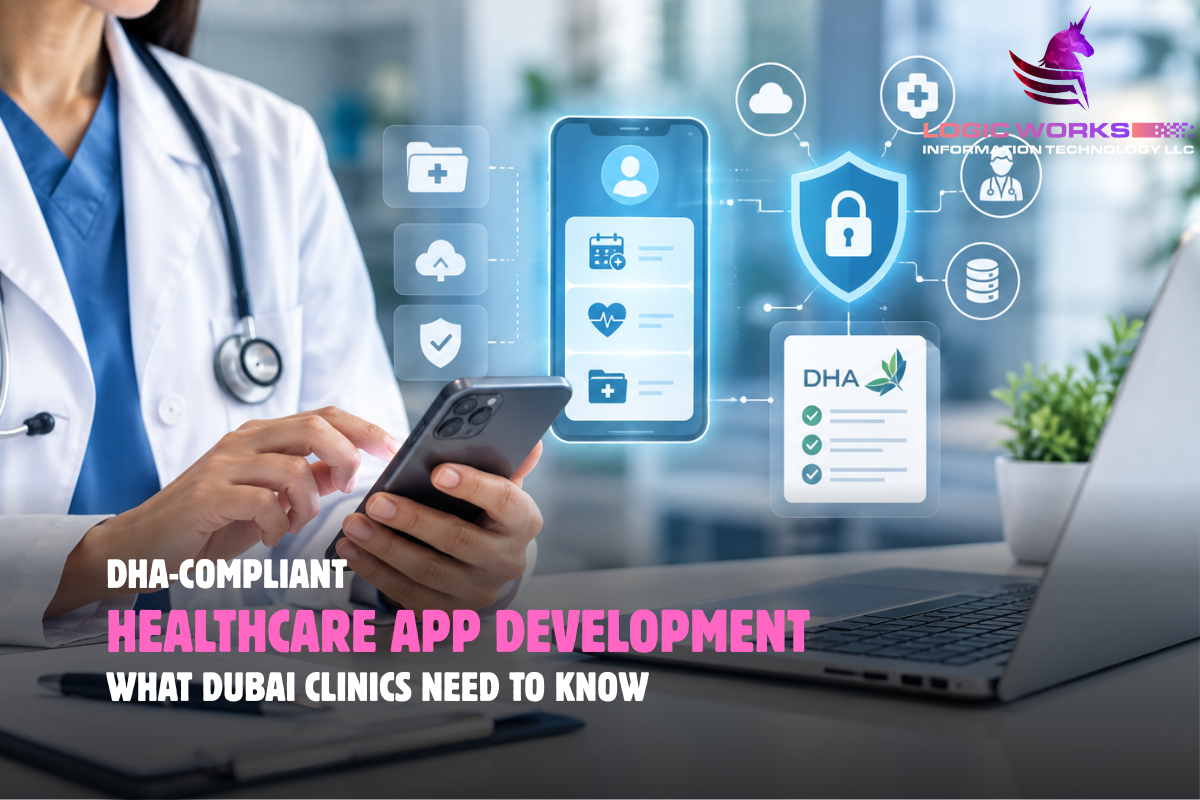
Building a healthcare app in Dubai involves more than creating appointment screens, patient profiles, and notifications. Healthcare App Development for clinics must also account for how sensitive health information is collected, accessed, exchanged, and protected. For Dubai healthcare providers, that means understanding relevant Dubai Health Authority requirements, UAE health-data rules, and the technical standards that may apply to services such as telehealth and electronic medical records.
Compliance should not be treated as something to check at the end of development. It needs to influence the app architecture, user roles, integrations, data flows, and security decisions from the beginning.
What Does DHA Compliance Mean for a Healthcare App?
There is no single technical feature that makes an app “DHA compliant.”
The requirements depend on what the application actually does.
A simple clinic appointment app has different risks from a platform that stores clinical records, supports remote consultations, connects to an Electronic Medical Record system, or allows doctors to review patient health information.
Dubai Health Authority regulates healthcare facilities and maintains standards covering areas such as telehealth, health information exchange, data quality, and clinical information. DHA’s current Telehealth Services Standards, Version 4, took effect on November 26, 2025 and cover services including teleconsultation, telemonitoring, telepharmacy, telediagnostics, and other remote-care models.
At the UAE level, healthcare technology also operates within a broader legal framework. Federal Law No. 2 of 2019 regulates the use of information and communication technology in health fields, while the UAE Personal Data Protection Law provides rules for handling personal information more generally.
For clinics, the practical lesson is simple: define what the app will do before deciding which compliance requirements apply.
Why Compliance Planning Should Start Before Development
Security and compliance become much harder to fix after an application has already been built.
Imagine a patient app that initially gives every clinic employee broad access to medical records. Adding proper access levels later may require changes to the database, authentication system, admin dashboard, APIs, and audit history.
The same problem can happen with integrations.
If a clinic expects its app to connect with an EMR or Dubai’s health information exchange environment, that requirement should influence the architecture from the planning stage.
Good healthcare software development in Dubai therefore starts with a data-flow discussion.
The development team should understand:
- what patient information will be collected
- why that information is needed
- who should be able to access it
- where information will be stored
- which external systems will receive it
- whether telehealth features are involved
- what records need to be retained
- how access and changes will be tracked
These decisions shape the technical foundation of the product.
Protect Patient Data With Appropriate Access Controls
Healthcare applications often involve several user types.
A clinic app might include patients, doctors, nurses, reception staff, administrators, and external service providers. They should not automatically have access to the same information.
Role-based access control helps limit users to the information and functions required for their work.
For example, reception staff may need appointment information without needing full access to a patient’s clinical history.
Authentication is equally important. DHA’s NABIDH authentication and authorization policy addresses identity verification, appropriate access privileges, and the ability to identify users who have accessed or modified patient records within that environment.
For an app project, this means access control should be designed around actual clinical and operational roles rather than a simple choice between “user” and “admin.”
Keep an Audit Trail
Sensitive healthcare systems need accountability.
A useful audit trail can record events such as:
- who accessed a record
- when access occurred
- what information was changed
- which account performed the action
- when permissions changed
- when important clinical information was updated
Audit logging is particularly important when multiple people and systems interact with the same patient data.
It can also help clinic administrators investigate unexpected activity instead of relying on guesswork.
Plan Carefully for NABIDH and EMR Integration
NABIDH is Dubai’s health information exchange platform. Its purpose is to support secure exchange of healthcare information across participating public and private healthcare facilities and provide a more connected view of patient records.
This matters when a clinic’s mobile application needs to interact with its EMR.
In May 2025, DHA issued a circular concerning the implementation of EMR systems compliant with NABIDH integration requirements and Single Sign-On authentication for healthcare facilities covered by the mandate.
An app should therefore not be designed as an isolated database if the clinic’s workflow requires information to move between the application, EMR, and other approved systems.
Before development, clarify:
- which system is the primary clinical record
- what information the app needs to read
- what information it needs to write
- how patient identities will be matched
- what APIs or integration methods are available
- what happens if an integration fails
- which actions should be logged
Integration planning early can prevent expensive redevelopment later.
Telemedicine Apps Need Additional Attention
A normal booking application and a telemedicine platform are not the same thing.
Once an app supports remote consultations, monitoring, diagnosis-related workflows, prescriptions, or other clinical services, additional requirements may apply.
DHA’s current Telehealth Services Standards cover several forms of remote healthcare delivery and establish requirements for providers operating telehealth services in Dubai.
A telemedicine app may need to account for areas such as:
Patient Identification
The system should support reliable identification of the people participating in the healthcare interaction.
Consent and Communication
Patients should understand the service they are using and how their information may be handled within the applicable care workflow.
Clinical Records
Remote consultations should fit into the provider’s wider clinical record process instead of becoming disconnected conversations.
Secure Communication
Video, messaging, documents, and other health information need appropriate protection while being transmitted and accessed.
Clinics should confirm the exact regulatory requirements for their service model before launching telehealth functionality.
Think Beyond Passwords When Designing Security
A secure healthcare app requires more than a login screen.
Security planning may include:
- strong authentication
- appropriate session controls
- encryption for sensitive information
- secure API design
- permission management
- server and database protection
- controlled administrative access
- software update processes
- backups and recovery planning
- monitoring and audit logs
The level of protection should reflect the sensitivity of the information and the risks associated with the application.
UAE data protection rules also place responsibilities on organizations processing personal information, including requirements around security and confidentiality.
Design Privacy Into Patient-Facing Features
Healthcare apps collect information in many places, not only medical-record screens.
Consider:
appointment forms
registration details
uploaded reports
chat messages
payment information
push notifications
contact forms
prescription-related workflows
Developers should ask whether each piece of information is necessary and who needs access to it.
Notifications deserve particular attention. A phone’s lock screen may be visible to other people, so displaying unnecessary medical details in a push notification can create avoidable privacy concerns.
Simple product decisions can have real privacy consequences.
Build for Arabic and English Users
Dubai clinics often serve multilingual populations.
An English and Arabic healthcare app should be planned as a genuine multilingual product rather than translating screens at the end of development.
Arabic interfaces may require right-to-left layouts, navigation adjustments, flexible components, and testing across different device sizes.
Clinical terminology also needs careful handling. A literal translation may not always be suitable for patient communication.
The goal is not simply to support two languages. Patients should be able to understand instructions, appointments, consent information, and important actions clearly in the interface they use.
Common Healthcare App Development Mistakes
Several problems can create unnecessary risk or rework:
Building First and Checking Compliance Later
Compliance requirements can affect architecture. Treating them as a final checklist often leads to expensive changes.
Giving Too Many Users Access
Permissions should follow real job responsibilities.
Creating a Separate Data Silo
A standalone app may create duplicate records and manual work if integration requirements were ignored during planning.
Installing Too Many Third-Party Services
Every analytics tool, messaging platform, SDK, and external API should be evaluated before sensitive information is shared with it.
Ignoring Operational Workflows
Even technically strong software can fail if doctors and clinic staff cannot use it efficiently during real patient care.
Questions to Ask Before Hiring a Healthcare App Development Partner
Before choosing a development company, ask practical questions.
How will patient data move through the system?
How will different staff roles be managed?
Has the integration architecture been planned before development?
How will access to sensitive records be logged?
How will the team handle EMR integration?
What security testing is included?
How will Arabic and English interfaces be tested?
What happens after launch when requirements change?
A capable development partner should be able to explain these decisions clearly without hiding behind technical jargon.
Building a Healthcare App for Dubai Requires More Than Features
Healthcare apps can make booking, communication, remote care, and patient access more convenient. But convenience cannot come at the expense of privacy, security, or reliable clinical workflows.
Dubai clinics should begin by defining what the application will do, what health information it will handle, and which systems it needs to connect with. Compliance, security, access control, and interoperability can then be built into the project instead of added later.
Logic Works Information Technology approaches healthcare projects by considering both the user experience and the technical systems behind it. For clinics planning a new platform, patient portal, telemedicine solution, or mobile application, the strongest starting point is a clear requirements and compliance review before development begins.
Because healthcare regulations and DHA standards can change, clinics should also confirm the requirements that apply to their specific facility and service model with the relevant regulatory or compliance professionals before launch.