
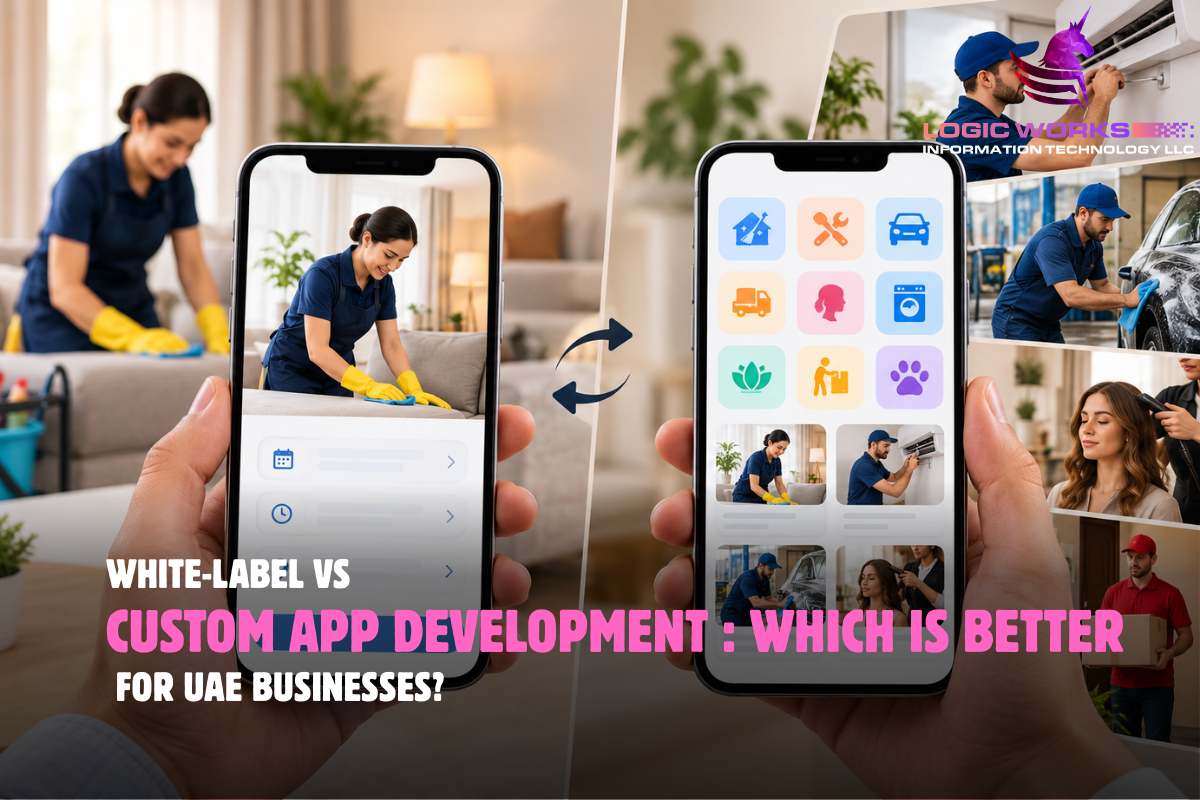
Choosing between a white-label app and a custom-built mobile application is one of the first decisions a UAE business needs to make before development starts. A reliable app development company in dubai should help you compare more than the initial price. Launch speed, ownership, branding, integrations, future features, maintenance, and long-term costs all matter. The cheapest way to launch is not always the cheapest way to operate three years later.
Both approaches have a place. A white-label solution can help a business enter the market quickly, while custom mobile app development gives you more control over how the product works and grows.
The better choice depends on what you actually need.
What Is a White-Label Mobile App?
A white-label mobile app is a pre-built application that a provider adapts for different businesses.
The basic system already exists. The provider usually changes the logo, brand colors, business information, and selected features before publishing the app under your company name.
For example, a restaurant ordering platform might use the same technical foundation for dozens of restaurants. Each business gets its own branding, menu, pricing, and contact details, but the underlying application remains largely the same.
This approach can reduce development time because the main product does not need to be built from scratch.
White-label app development can work well for businesses with standard requirements and a clear need to launch quickly.
What Is Custom Mobile App Development?
A custom app is designed around the requirements of one business.
Instead of adjusting an existing template, the development team plans the user experience, workflows, database, integrations, administration tools, and technical architecture based on the project’s actual needs.
That gives the business greater control over how the application behaves.
A custom delivery platform, for example, could use unique driver allocation rules, customer pricing, service zones, membership plans, business dashboards, and integrations with an existing ERP or CRM.
Custom app development usually requires more planning and a larger initial investment, but it can provide more flexibility as the business grows.
White-Label vs Custom App Development: What Is the Main Difference?
The simplest difference is ownership and flexibility.
A white-label app asks:
How closely can your business fit an existing platform?
Custom mobile application development asks:
How should the platform fit your business?
That distinction affects almost everything that follows, including cost, development timeline, feature flexibility, integrations, scalability, and maintenance.
Which Option Is Cheaper?
White-label apps generally have a lower upfront cost.
Most of the engineering work has already been completed, so you are mainly paying for setup, branding, configuration, publishing, and sometimes ongoing licensing.
This can make white-label software attractive to startups and smaller businesses that want to validate an idea without investing heavily in technology.
However, businesses should also look at recurring costs.
Some white-label providers charge monthly fees, annual licensing, transaction commissions, per-user fees, or additional charges for premium features. These costs can become significant as the business grows.
A custom app normally costs more at the beginning because the development team needs to design and build the system specifically for you.
The long-term picture can be different, especially when the business owns the source code and does not depend on ongoing platform licensing.
Which Option Gets to Market Faster?
White-label applications usually win on launch speed.
A simple branded version of an existing system may be ready much faster than a completely new product.
For a business testing a standard concept, that speed can be useful.
Custom development takes longer because developers need to understand requirements, create designs, build features, test integrations, complete quality assurance, and prepare the application for release.
But faster is only better when the existing platform already supports what the business needs.
Trying to force an unusual workflow into a rigid white-label system can eventually cost more time than building the right solution from the beginning.
How Much Control Do You Have Over Features?
This is where custom development has a clear advantage.
White-label apps normally give businesses a fixed selection of available features. You may be able to enable or disable modules, but changing how the core system works can be difficult or impossible.
That may be perfectly acceptable for a straightforward booking, ordering, loyalty, or service application.
Problems begin when your business needs something different.
Perhaps your pricing changes by customer type. Maybe you need a custom approval process, a specific payment flow, live inventory from another platform, or different permissions for each type of user.
Custom mobile app development gives you more freedom to build those requirements into the product.
What About Branding and User Experience?
White-label platforms usually allow visual customization.
You can often change colors, logos, images, and basic content. However, the navigation and user journey may remain similar to every other app using the same platform.
For some businesses, that is enough.
For brands where the mobile experience plays a major role in customer retention, a more distinctive interface may matter.
A custom application allows the design to reflect the actual customer journey instead of fitting the journey into an existing template.
That can be particularly useful for marketplaces, fintech products, logistics platforms, healthcare systems, subscription services, and other applications with more complex workflows.
Source Code and Data Ownership Matter
Ownership is easy to overlook during the early stages of a project.
Before choosing a white-label application, find out who owns the source code and what happens to your data if you stop using the service.
Can you move the application to another provider?
Can another development team modify it?
Can you export all customer and transaction data?
What happens if the vendor changes its pricing?
A custom application can provide greater independence when the agreement gives your business full ownership of the source code, database, documentation, and cloud environment.
This is something to discuss clearly before signing any mobile app development contract.
Think About Integrations Before Choosing
Many UAE businesses do not operate their apps independently.
The mobile application may need to connect with an ERP, CRM, accounting platform, payment gateway, delivery provider, inventory system, customer support tool, or internal software.
A white-label platform may already support popular integrations, which can save time.
But if your business relies on a custom system or a less common API, integration options may be limited.
A software development company in dubai can review those dependencies before development begins and determine whether an existing platform can support them without expensive workarounds.
Which Option Scales Better?
Scalability is not simply about handling more users.
Growth can mean adding new locations, service categories, subscription plans, user roles, currencies, languages, integrations, or business models.
White-label platforms can scale well when your future plans remain within the platform’s existing structure.
Custom software offers more flexibility when those future requirements are unique.
For UAE businesses planning regional expansion, it is worth considering requirements such as Arabic and English interfaces, right-to-left layouts, UAE payment gateways, different service areas, and GCC expansion before choosing the underlying platform.
When Does a White-Label App Make Sense?
A white-label app can be a practical choice when your business needs standard functionality, wants a faster launch, has a limited initial budget, or is testing demand before making a larger investment.
It can also work well when the technology itself is not your main competitive advantage.
A business launching a straightforward appointment booking app may not need a completely custom technical platform.
There is no benefit in paying for complexity you will never use.
When Is Custom App Development the Better Choice?
Custom development becomes more attractive when your application is central to the business.
If you need proprietary workflows, complex integrations, unique customer experiences, several user types, advanced reporting, automation, or a long-term product roadmap, owning the technology can provide greater flexibility.
It is also worth considering when an existing white-label platform would require so many compromises that the final product no longer matches how the business operates.
Can You Start White-Label and Move to Custom Later?
Yes, and for some businesses this can be a sensible strategy.
A company might launch a white-label MVP to validate demand, understand customer behaviour, and test pricing.
Once the concept is proven, it can invest in a custom platform built around what it learned.
The important part is planning the transition.
Make sure customer data can be exported, understand your contract terms, and avoid becoming dependent on systems that cannot be migrated later.
How Logic Works Information Technology Approaches the Decision
At Logic Works Information Technology, the choice should start with the business model, not with a preference for one development method.
A company that needs a simple, proven workflow may not benefit from building everything from scratch. Another business with custom operations, integrations, or ambitious product plans may quickly outgrow a template-based solution.
The useful questions are straightforward: What needs to happen at launch? What will change over the next few years? Which systems must connect to the app? Who needs to own the technology?
Those answers make the decision much clearer.
Final Thoughts
White-label and custom app development solve different problems.
White-label apps can reduce initial cost and shorten time to market. They make sense when your requirements are standard and the existing platform already does what you need.
Custom apps require more investment upfront, but they give businesses greater control over features, integrations, branding, source code, and future growth.
Do not choose based only on the first development quote.
Compare ownership, recurring fees, customization limits, integration requirements, maintenance costs, and your long-term product roadmap. The right option is the one that supports how your business actually plans to operate and grow.